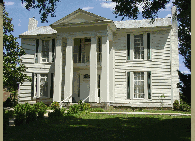
PLEASANT HILL Home of Rev. Robert Donnell (1784-1855)
Rev.
Robert Donnell wrote to a friend in 1851 that his house was finally
finished, and he had a "comfortable room in which to study." This room, now the gentleman's parlor was a favorite gathering spot for men who called, while their ladies were entertained in the parlor opposite.
Space for the present kitchen, office and restroom was once an open L-shaped porch, through which food was brought into the dining room from the outside kitchen. Daily
prayers were held there twice a day for the family, guests and
laborers. The overseer complained, in vain, that he was taking time away
from their work. The spiritual life of all those around him was more important to Rev. Donnell than the physical..
Large
porches on both floors caught the summer breezes and were used for
resting and sleeping, when the heat was too much for the three or four
beds per bedroom.
This was especially true after Donnell's only son, James Webb Smith Donnell, came to live in the house with his dozen or so children in 1855.
The
house, now surrounded by school buildings, is all that remains of the
250-acre estate, which once stood in the midst of hillside sloping down a
cedar-lined driveway to the stage road below. Behind it were the many outbuildings so necessary to Southern antebellum culture---the outdoor kitchen and privy, weaving, carriage and wash houses, blacksmith, garden plots, etc.
ROBERT DONNELL
Peace
treaties following the American Revolution were still being signed in
1784, when Robert Donnell was born in Guilford County, North Carolina. The
entire area was devastated and the Donnells soon joined others in
moving over the Cumberland Mountains to Wilson County, Tennessee, living
at first in a fort as protection against the Indians. The flatboat flotilla
containing household goods of the Donnells, was attacked at Nickajack
on the Tennessee River by Indians and all their possessions were lost.
Robert Donnell,
physically strong and mentally alert, showed an early interest in "The
Great Revival", which swept through the country in 1800, and he often
read his Bible while plowing the rocky ground on the family farm in
Wilson County, Tennessee. While still
in his teens, he was taken under the care of the Cumberland Presbytery,
and in 1809 came as a missionary to the present North Alabama area
(then part of the Mississippi Territory) where he is said
to have held the first camp meeting in the present Madison County.
Donnell was the chief author of the Confession of Faith for the new
Cumberland Presbyterian Church, which was officially founded in 1810. It was at a meeting in Jackson County, Tennessee that Donnell met Ann Eliza Smith, daughter of Revolutionary Colonel James
Webb Smith, founder of the county seat of Gainesboro and for whom Smith
County, Tennessee, was named. Robert and Ann Eliza were married in
1818, and she died a decade later, leaving only one of the five children born to them, James Webb Smith Donnell, who lived to maturity. By 1834, when Donnell
married Clarissa Lindley, daughter of the founder and first president
of the University of Ohio, he had established a number of C.P. churches and schools, including the one in Athens. In the 1840s he was instrumental in founding Cumberland University
in Lebanon, Tennessee, and taught there for some time before returning
to Athens to supervise the building of his house by Alexander Hamilton. It may have been
Clara's influence that caused the graceful stairway in the home to
offset the masculine woodwork here. Robert Donnell died here in May
1855, soon after completion of his book, "Thoughts On Various Subjects."
He was spared the heartache of seeing his home invaded by Union
soldiers and the death of his beloved granddaughter, Nannie Donnell.
It was in May, 1862 when Col. John
Turchin, Russian Cossack in the Federal army, quartered his soldiers on
the Donnell property while the "sacked and plundered" Athens. Turchin
would have been court-martialed by Gen. James A. Garfield, had he not been promoted to general through the influence of his wife Nadine Turchin.
The
Donnell family lost the house to bankruptcy in 1869 and it was then
used for a boys' school, which merged with Athens High School. The
house served as the residence of school principals until 1970, when the
late Julian Newman, Sr., retired after 25 years as principal and
superintendent of Athens city schools. It was primarily due to memorial
gifts to the house after the death of Mr. Newman that the upstairs rooms
were restored. In
the entrance hall can be seen his desk, a gift from the Newman family.
Also here are the pipe rack and pipes, a trademark of the popular
educator.
LOG CABIN KITCHEN
When
the Donnell family was forced to leave this house, they moved to the
Druid Grove plantation at Greenbrier, founded by Mrs. Donnell's
grandfather, Col. Lewellyn
Jones, and continued by her father, John Nelson Spotswood Jones. On this
extensive plantation was an original dog-trot cabin, dating back to the
1830s. A portion of this deteriorated and owners of the property, Ed
and the late Don Horton, donated the cabin to the house. Money to move
it was obtained by State Representative Tommy Carter and an anonymous
gift allowed us to restore it.
A Federal and Greek Revival window and door was donated by the Loggins family from the 1830s log Faser home. Athens' master furniture maker, Earl Bowers, made a duplicate Federal window for us. This is the first place bid upon each year for decoration for the Christmas Tree Festival.
In
the 1970s, a campaign to save and restore the house was initiated by
local historians and authors Christine W. Edwards and Faye A. Axford.
Local citizens, businesses and Donnell descendants contributed to the
restoration of this historical landmark.
For
several years during long and expensive restoration of the house, it
was under the auspices of the Limestone County Historical Society, but
in 1994 the house and log cabin were incorporated under the Donnell
House Board, which holds a 99 year lease from the Athens City Board of
Education
The
Donnell House was added to the National Register of Historic Places in
1973, and is currently used for hosting special events and guided tours.










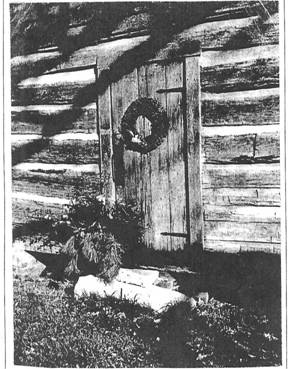 A Federal and Greek Revival window and door was donated by the Loggins family from the 1830s log Faser home. Athens' master furniture maker, Earl Bowers, made a duplicate Federal window for us. This is the first place bid upon each year for decoration for the Christmas Tree Festival.
